
Data
Assessment
Pupils at Hollywater School are assessed termly based on a range of factors unique to them. Evidence for this assessment is varied and moderated. Sources include developmental assessment frameworks, engagement profiles, understanding of engagement motivators, recorded observations (video, photographs, written), pupil progress meetings and professional opinion. The developmental assessment frameworks that form part of this process are also matched to the needs of the individual pupil and the overarching aims of the curriculum pathway that they are currently accessing.
Progress and attainment is judged using the following criteria :
- Emerging: Beginning, initiating, progressing, evolving, exploring.
- Developing: Advancing, improving, growing, maturing, refining.
- Secure: Established, proficient, confident, assured, accomplished.
These are recorded as Red, Amber and Green respectively for each area of development within their curriculum pathway. Pupil progress reviews are undertaken termly in October ( baseline data and expected outcomes ), March ( mid-year data) and June/July ( end of year data ) and are led by the Deputy Headteacher. Within these reviews discussion are had around whether the pupil is making :
- Below expected progress – interventions / support needed
- Expected progress – pupil is on track
- Above expected progress – pupil has exceeded expectations
In order for progress with a specific outcome or area to be defined as ‘Above expected progress’ the pupil’s engagement motivators must be well understood. It must be evident that these have been utilised in the classroom environment to secure intrinsic engagement with learning: there must be evidence that the pupil is fully engaged in meaningful learning. The outcome(s) being judged must be relevant to the pupil’s longer term aspirations and/or development. There is an expectation that the pupil will have made developmental progress, even if that is laterally via increased maintenance, fluency, independence or generalisation. Quantitative progress against outcomes or identified assessment frameworks is considered in making the judgement for the individual pupil but its influence on the judgement is subjective based on the individual circumstances, disability and the general learning characteristics of the individual.
For a pupil to be considered to be making ‘Expected progress’ they will usually be making developmental progress, at least laterally, but the other cross-referenced and heavily moderated sources of evidence may suggest that this could be developed. Usually this will occur where a child’s engagement motivators are not well understood or classroom staff feel that they do not fully understand an aspect of the child’s development such as their expressive communication or self-regulation.
Where a child is making ‘ Below expected progress ‘ or their presentation of engagement and engagement motivators are not well understood. In these cases, prolonged discussion and observation of the pupil will take place in the identified area(s) of development and classroom staff will be supported by senior leaders (as well as identified multi-professionals) to better understand how to engage the pupil in learning and support their progress.
Earwig – Hollywater School assessment tool
At Hollywater School we use Earwig as an assessment tool to map pupil progress against an individualised curriculum. Part of this process is an assessment for learning cycle to ensure personalisation of planning and delivery of activities.
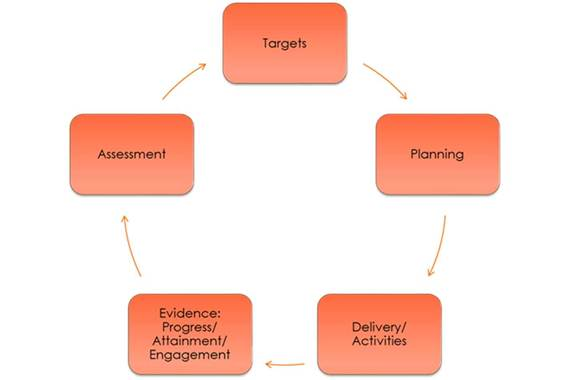
This assessment for learning cycle is used to assess progress against pupils personalised curriculum pathway. Teachers use it to evidence, assess and track progress. Linking evidence to support progress towards targets. Within the evidence gathering process teachers make comments on progress linked to learning objectives, they use photos/videos to evidence progress made and they make judgements on level of support needed and level of engagement shown. This evidence gathering process then enables the teacher to identify next steps in the pupils learning.
Earwig is not only used to assess progress against curriculum pathways. It is also used for evidencing and tracking progress against individual Personalised Learning Plan targets related to Cognition and Learning, Communication and Interaction, Personal, Social, Emotional and Mental Health and Physical and Sensory Development. These are linked to pupil’s aspirations as set out in their Education Health & Care Plans (EHCP). Links are made to Preparation for Adulthood and developmental plans provided by Health professionals such as Speech and Language Therapists, Physiotherapy, Occupational Therapists and Mental Health professionals. Earwig provides a platform that allows clear and precise overviews of pupil progress towards their aspirational outcomes and ambitions.
As Earwig supports any assessment framework and any assessment model we use it across ALL pathways with ALL pupils.